Drop an audio or video file here, or select one from this device.
All audio and video formats acceptedHandle Turkish spelling, speaker changes, timecodes, and final review in one practical workflow
Dotted İ, dotless ı, long suffix chains, and proper-name forms such as Ankara'da stay easier to review. Casing and punctuation remain editable.
Interviews and meetings become easier to follow with speaker labels and time-linked turns. Names can be assigned during the review stage.
Turn Turkish videos into synchronized captions. Adjust line breaks and timing, then download SRT or VTT files for publishing and accessibility.
Check names, numbers, and specialist terms in the browser editor. Download the finished transcript in practical text, document, or subtitle formats.
| SpeechText.AI | Google Cloud | Amazon Transcribe | Microsoft Azure | OpenAI Whisper | SESTEK | Meta MMS | |
|---|---|---|---|---|---|---|---|
| Accuracy and WER for Turkish | 91-96% accuracy; 4-9% WER (estimate/placeholder; Common Voice 17.0 Turkish and FLEURS tr_tr basis, no audited public score) | 88-94% accuracy; 6-12% WER (estimate/placeholder; same-corpus basis, no public Turkish cross-vendor result) | 84-91% accuracy; 9-16% WER (estimate/placeholder; same-corpus basis and documented tr-TR support) | 87-93% accuracy; 7-13% WER (estimate/placeholder; same-corpus basis and Azure Turkish model availability) | 89-95% accuracy; 5-11% WER (estimate/placeholder; FLEURS trends from Radford et al. and Whisper model cards) | 86-93% accuracy; 7-14% WER (estimate/placeholder; Turkish vendor capability pages, no public corpus score) | 82-90% accuracy; 10-18% WER (estimate/placeholder; FLEURS and Common Voice trends from MMS paper/model cards) |
| Supported formats | Most audio and video formats with automatic audio extraction | FLAC, LINEAR16, MP3, OGG/Opus, WebM, and more | AMR, FLAC, M4A, MP3, MP4, OGG, WebM, WAV | WAV/PCM, MP3, OGG/Opus, FLAC, WebM | Common media formats through FFmpeg | Common media and telephony formats; plan dependent | Primarily PCM/WAV after preprocessing |
| Domain Models | Yes, including business, finance, legal, medical, education, and more | Model selection, phrase hints, and adaptation options | General Turkish model; vocabulary options vary by locale | Custom Speech features vary by locale and region | General multilingual model with prompt guidance | Vertical and custom solutions available by contract | General single-language ASR without domain models |
| Speech Translation | Turkish transcription with English translation output | Separate Cloud Translation step required | Separate Amazon Translate workflow required | Turkish source translation through Azure Speech services | Turkish speech can be translated into English | Separate offering; target language support should be confirmed | No, transcription only |
| Free Technical Support | Included | Documentation and community; paid support plans | Documentation and community; paid support plans | Documentation and community; paid support plans | Community support only | Contract-based vendor support | Open-source community support |
Go from a recording to an editable Turkish transcript without preparing a special file format
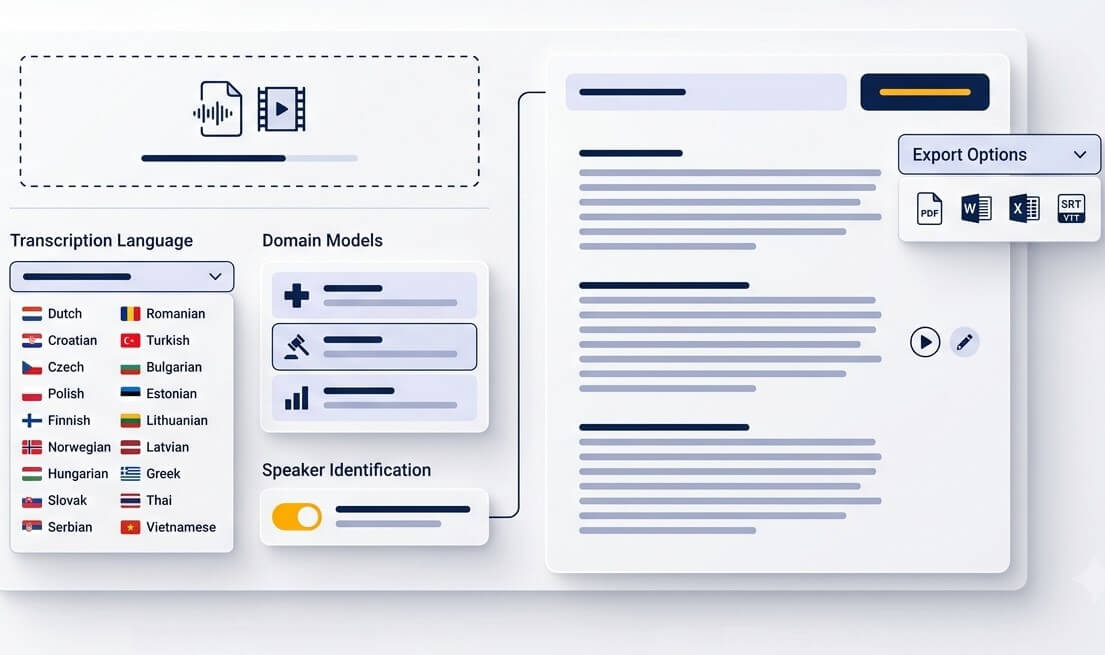
Upload MP3, WAV, M4A, AAC, FLAC, OGG, OPUS, WEBM, MP4, MOV, or another common media file. The original audio remains available for time-linked review.
Set the spoken language to Turkish and select the closest subject area. Relevant context helps with specialist terms, abbreviations, organization names, and uncommon vocabulary.
Listen to difficult passages, correct speaker names, and check dates or figures. Export the approved text as a document or create synchronized SRT and VTT subtitles.
Make spoken information searchable, quotable, and easier to share without replaying the full recording
Convert Turkish voice messages, site observations, and quick interviews into organized notes. OGG and M4A files can be uploaded without manual conversion.
Create a searchable record of presentations and group discussions. Locate definitions, quotations, and exam topics without scanning hours of audio.
Add captions to tutorials, product guides, and internal videos. For Turkish video subtitling, SRT and VTT exports provide editable text with timecodes.
Keep each contribution easy to trace with speaker turns and timestamps. Search the transcript for themes before returning to the original audio.
Produce a Turkish source transcript before creating an English version. This gives editors a clear reference for names, idioms, numbers, and cultural terms.
Find customer questions, objections, and next steps in recorded calls or demos. Obtain recording permission before processing private conversations.
Use structured transcripts where accurate quotations, clear speakers, and fast retrieval matter
Create searchable drafts from recorded negotiations, policy briefings, and approved internal interviews. Timestamps help reviewers verify important wording against the source.
Process research interviews, medical lectures, and staff training material with a relevant domain setting. Specialist names and clinical statements should receive human review.
Turn press briefings, campaign research, and customer panels into source material for reports. Speaker labels make quotations easier to attribute and check.
A dependable transcript handles more than sound by making spelling, speakers, and source verification easy to manage
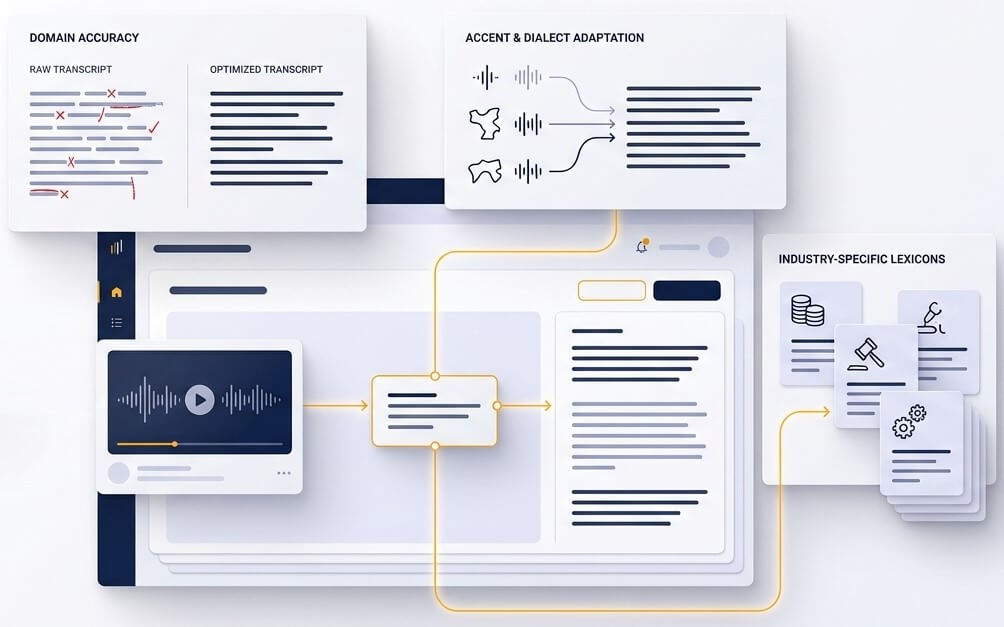
Turkish spelling is regular, but speech still creates difficult word boundaries, abbreviations, and proper names. Dotted i and dotless ı cannot be exchanged, while suffixes attached to names may require forms such as İstanbul'da or Ayşe'nin. Editable casing and punctuation make these details easier to compare with the recording instead of accepting an unchecked automatic draft.
A useful transcript needs a clear path back to the source. Time-aligned text and separate speaker turns reduce the effort required to verify a quotation or unclear phrase. This matters in Turkish meetings where fast exchanges, interruptions, English brand names, and regional pronunciation can lower automatic accuracy. Overlapping speech should always receive a manual check.
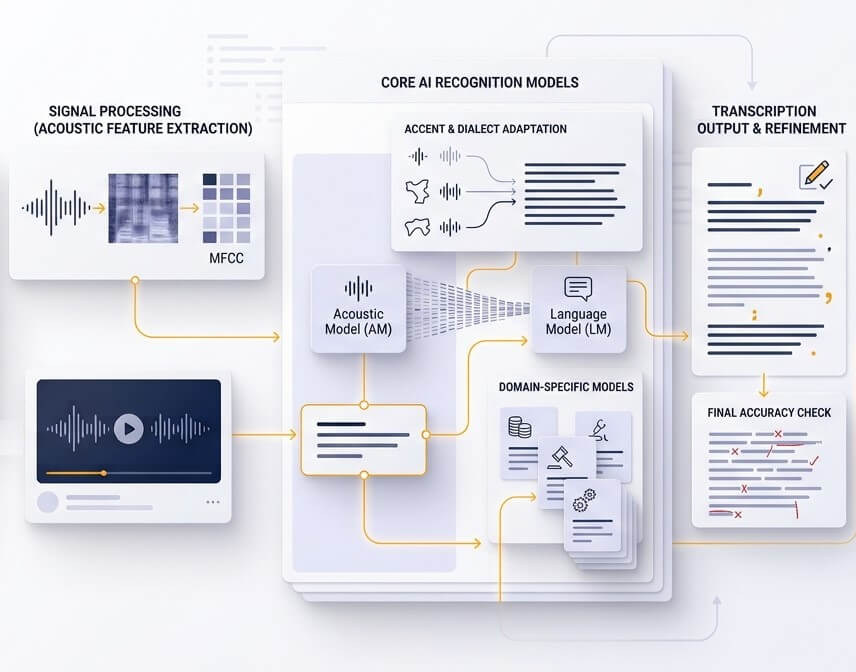
Reliable Turkish voice to text software should support verification, not hide uncertainty. Select the closest subject area, scan names and figures, replay doubtful passages, and export only after review. Clean single-speaker audio normally performs best. Distance from the microphone, background music, cross-talk, and rare terminology can increase word error rate even with a strong recognition model.
No single accuracy percentage applies to every recording. Clear speech from one close microphone usually falls near the upper end of the indicative ranges in the comparison table. Noise, overlapping voices, distant microphones, uncommon names, code-switching, and strong regional pronunciation increase word error rate. Human review remains appropriate for publication, research evidence, medical material, or legal use.
Yes. A Turkish recording can be converted into a source transcript and then rendered as English text or subtitles. Keeping the Turkish version makes translation review easier, especially for personal names, institutions, idioms, dates, and place names. Important translated material should be checked by a fluent speaker before publication.
Files are transferred through encrypted connections, and account controls allow uploaded media and transcripts to be deleted. Recording permission should be confirmed before processing calls, interviews, or meetings. Organizations with formal retention, residency, or contractual requirements should review the applicable service terms or contact support before uploading sensitive material.
New accounts can use free trial transcription credit to test a Turkish recording before choosing a paid plan. The trial is useful for checking speaker separation, spelling, timing, and performance on a specific accent or recording setup. It is a limited evaluation rather than an unlimited free transcription service.
Yes. Upload a Turkish video, review the transcript, adjust line breaks and timestamps, and export synchronized SRT or VTT captions. The platform also accepts common audio and video formats such as MP3, WAV, M4A, FLAC, OGG, WEBM, MP4, and MOV, so separate audio extraction is usually unnecessary.
The Turkish model can process standard Turkey Turkish, regional pronunciation, and recordings that contain some English names or technical terms. Results depend on audio quality and how often speakers switch languages. Black Sea, Aegean, Central Anatolian, Eastern Anatolian, or heavily colloquial speech may need more editing than clear Istanbul Turkish.